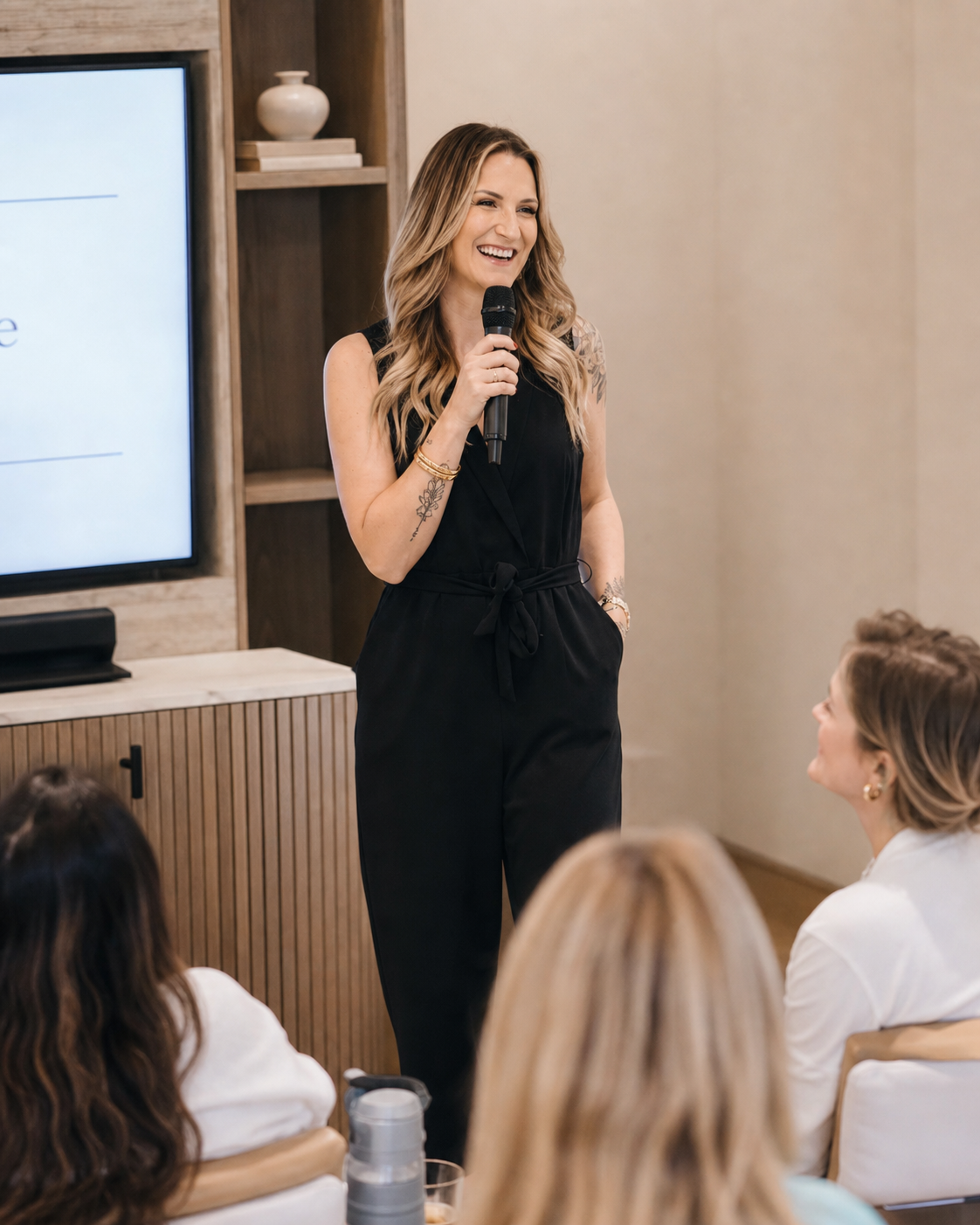
118. Stop Chasing Likes: How Tara Lassiter Uses LinkedIn & Substack to Land Real Clients


There is a special kind of dread that hits when someone tells a creative founder, “You should really be using LinkedIn.”
Suddenly you can hear the imaginary sound of a conference room projector warming up.
You picture people with job titles that require seventeen syllables. You see “thought leadership” posts that begin with “I’m humbled to announce…” You feel the Patagonia vest energy creeping toward you like a fog.
And yet.
LinkedIn might be one of the most underused visibility platforms for creative entrepreneurs, consultants, coaches, service providers, and small business owners who actually want conversations that lead somewhere.
Not vanity metrics.
Not another carousel your cousin likes because she loves you.
Not posting into the void while whispering, “Please let this one convert.”
Real conversations. Real relationships. Real referrals. Real buyers. Real believers.
That was the heart of my conversation with Tara Lassiter on The Accidental CEO Podcast. Tara has built a business around social selling, relationship-based marketing, content, email, and helping founders turn online presence into actual pipeline. And her approach is refreshingly human.
No pitch-slapping.
No copy-paste “Hey friend” weirdness.
No pretending you read someone’s entire profile when you clearly did not.
Just strategy, curiosity, and the radical idea that people enjoy being treated like people.
Imagine that.

Why LinkedIn Feels Gross When You’re Doing It Wrong
Let’s start with the obvious: a lot of LinkedIn outreach feels terrible.
Not because outreach itself is bad.
Not because selling is bad.
Not because wanting clients makes you some kind of capitalism goblin.
It feels terrible because people move too fast.
Tara described it perfectly: think of LinkedIn like a dinner party.
At a dinner party, it is normal to ask someone what they do. It is normal to talk about your work. It is normal to connect over shared interests, mutual friends, kids, cities, industries, hobbies, or the fact that neither of you knows whether it is pronounced GIF or JIF.
What is not normal?
Walking into the room, grabbing a stranger by the shoulders, and saying, “Do you want to book a discovery call?”
That is not networking. That is a hostage situation with a Calendly link.
The reason so many founders feel slimy in the DMs is because they are skipping the human part. They are treating every connection like a potential transaction instead of a potential relationship.
Tara’s approach is slower, warmer, and much more sustainable.
Start with curiosity.
Say thank you.
Ask a simple question.
Notice something real.
Talk to people the way you would talk to them if you bumped into them at an event, a coffee shop, or a friend’s dinner table.
This does not mean you hide what you do. It means you stop leading with pressure.
Buyers and Believers: The Network You Actually Need
One of Tara’s best phrases from the episode was “buyers and believers.”
Most founders are obsessed with buyers.
And listen, I love a buyer. Buyers pay invoices. Buyers keep the lights on. Buyers make it possible to do noble things like pay your mortgage and buy the good cheese.
But believers matter too.
Believers refer you.
Believers share your work.
Believers remember your name when someone in their circle needs what you do.
Believers open doors you could not have forced your way through.
When you look at LinkedIn only as a place to find immediate clients, you accidentally turn every conversation into a pressure cooker. You start evaluating people too quickly. Are they a lead? Are they ready? Do they have budget? Are they going to buy?
That energy is loud. People can feel it.
A wider relationship strategy gives everyone more room to breathe.
Some people will become clients. Some will become collaborators. Some will become referral partners. Some will become community. Some will simply remind you that the internet is not entirely a dumpster fire.
That is still valuable.
Relationship-based marketing is not slow because it is soft. It is strong because it compounds.
Why LinkedIn Is a Goldmine for Creative Founders
A lot of creative entrepreneurs avoid LinkedIn because it feels too corporate.
And honestly, fair.
There are absolutely bros and bots on LinkedIn. There are also bros and bots on every platform. Instagram has them. TikTok has them. Facebook has them. Your inbox has them. We are not escaping the bots, friends.
But LinkedIn has something most platforms do not: search power.
On Instagram, you are often guessing. On TikTok, you are trying to catch attention in a feed designed to move faster than your nervous system can process. On LinkedIn, you can be much more intentional.
You can search by role, industry, location, company, school, connection level, years in business, and other signals that help you find people who are more likely to be aligned with your work.
That does not mean you send them a message saying, “I help people like you.”
Please do not.
As Tara pointed out, nobody likes that. It feels presumptuous because you do not actually know them yet.
Demographics can help you find the door. Conversation helps you understand the person behind it.
That is the difference.
LinkedIn can help you find people who may fit the outer shape of your audience. But the DMs, the comments, the conversations, and the relationship-building are where you learn what they care about, what they are working on, what they are struggling with, and whether there is a real connection there.
Stop Looking for Pain Points in Public Posts
Here is something Tara said that every service provider needs to tattoo on their marketing brain:
LinkedIn is a celebration platform.
People post about promotions, podcasts, speaking gigs, launches, features, hires, client wins, and new offers. It is a place where people polish the window a little before they invite the internet to peek inside.
So if your offer solves a problem that someone might feel embarrassed about, they probably are not posting about it publicly.
They are not writing, “Wow, my sales pipeline is a disaster and I have no idea how to talk about what I do.”
They are not posting, “I hired help and now I’m redoing everything myself because I do not know how to delegate.”
They are not announcing, “Please clap, I am secretly overwhelmed and my business only works because I am over-functioning at a heroic and unhealthy level.”
Those conversations usually happen privately.
Which means if you are only using content to look for buying signals, you are missing the point.
Content builds familiarity.
Comments create touchpoints.
DMs create context.
And context is where actual sales conversations can happen without forcing them.
How to Make LinkedIn DMs Feel Human
The first rule: stop trying to close in message one.
The second rule: see rule one.
A good DM does not have to be revolutionary. It just has to be real.
You can say:
“Thanks for commenting on my post. I loved your point about client communication. What kind of work are you doing right now?”
Or:
“I saw we both know Nata from the same business circle. I’m always happy to connect with other founders in this space.”
Or:
“I noticed you’ve been talking about building more sustainable visibility. That’s a topic I’m always nerding out about. What’s been working for you lately?”
None of those messages require fireworks.
They require attention.
That is the bar, and somehow most people still trip over it.
Tara also talked about using simple conversation starters and treating small talk like a skill. This is so important, especially for founders who tell themselves, “I’m just not good at networking.”
You do not have to be naturally extroverted. Tara even said she prefers one-on-one conversations.
You can collect prompts. You can practice. You can have a few easy questions ready for the days when your brain has left the building.
Small talk is not fake when it is used to create genuine connection. It is the little bridge that lets people decide whether they want to keep talking.

The Permission-Based Pitch
At some point, you are allowed to say what you do.
This is where some founders get weird in the opposite direction.
They are so afraid of being salesy that they become invisible. They have a lovely conversation, offer thoughtful advice, build rapport, and then disappear into the woods like a helpful business fairy.
No.
You are running a business.
You can mention your work.
You can connect the conversation back to your experience.
You can say, “I actually help clients with that.”
Then ask permission.
“Would you like to know more?”
“Do you want me to send you a resource?”
“Would it be helpful if I shared how I think about that?”
That tiny permission step changes the whole energy.
You are not lunging at them with an offer.
You are opening a door and letting them decide whether they want to walk through it.
That is what makes the difference between pressure and invitation.
Warm Introductions Still Work
If you do not want to pay for Sales Navigator or go deep into cold outreach, Tara recommends starting with the people you already know.
Look at your current connections.
Then look at their connections.
Those second-degree connections are often a goldmine because someone you already know may be able to make an introduction.
You can ask:
“Hey, I noticed you’re connected to this person. Do you know them well enough to make an intro?”
Or:
“Would you be comfortable if I mentioned your name when I reach out?”
This turns cold outreach into warm outreach.
It also creates cross-pollination between networks, which is exactly how real business relationships grow. Not through grabbing strangers off the internet and shoving your offer at them. Through trust moving from one person to another.
That is old-school networking with modern tools.
And it still works.
Substack, Email, and the Coffee Shop Strategy
Tara also shared how she used Substack as a more casual, personal platform.
Her line was brilliant: LinkedIn was her cubicle, Substack was her coffee shop.
LinkedIn was buttoned up. Substack gave her space to talk about business, motherhood, homeschooling, and the pieces of life that did not quite fit into LinkedIn’s culture.
What worked especially well for her was Substack Notes.
She repurposed old LinkedIn comments, snippets from posts, and short thoughts. She posted multiple times a day as a test, and in less than 90 days, she grew to 1,000 subscribers organically.
That is impressive.
But the more important lesson is what happened next.
Tara realized that audience growth on a platform does not automatically mean you have full control over the relationship. Substack was pushing more app-based engagement, and she noticed her email open rates drop. So she exported her list and began nurturing subscribers through a separate email platform.
This is the part founders need to pay attention to.
Substack can be useful.
Instagram can be useful.
LinkedIn can be useful.
TikTok can be useful.
But your business should not depend on a platform letting you reach the people you already worked hard to gather.
Your email list still matters.
Not because email is sexy. It is not. Email has the aesthetic appeal of a filing cabinet.
But it works.
And more importantly, it gives you a more direct relationship with your audience.
Choose the Platform That Matches the Game You Want to Play
A big takeaway from Tara’s episode is this: every platform has a culture.
LinkedIn has a culture.
Substack has a culture.
Instagram has a culture.
TikTok has a culture.
The mistake is trying to play the wrong game on the wrong platform and then blaming yourself when it does not work.
If your people are on TikTok but they are there to decompress, laugh, scroll, and watch a stranger reorganize a pantry, they may not be in the mindset to hire a business coach or marketing strategist.
That does not mean TikTok cannot be part of your strategy. It might be great for personal brand, storytelling, visibility, or nurture.
But know the job of the platform.
Are you there to be discovered?
To build authority?
To nurture?
To start conversations?
To drive people to your email list?
To sell directly?
Those are different jobs.
When you know what each platform is supposed to do, you stop expecting one channel to magically carry your whole business in a little algorithm tote bag.
Burned Out From Instagram? Use What You Have
If you are burned out from Instagram or TikTok and the idea of starting fresh on another platform makes you want to lie down under your desk, Tara’s advice is simple:
Use what you have.
That TikTok you recorded? It is a script.
That Instagram carousel? It can become a LinkedIn carousel.
That caption? It can become a newsletter opener.
That podcast idea? It can become a short-form video, a blog post, and a LinkedIn post.
That line you keep saying on client calls? That might be your next piece of thought leadership.
You do not need to reinvent yourself every time you try a new platform.
You need to translate.
Take what already worked and adapt it to the culture of the platform you are using now.
This is especially important for founders who are tired of feeding the content machine like it is a raccoon with a demanding personality.
Your ideas are allowed to work more than once.
In fact, they should.
Repetition Builds Trust
Founders often worry that they are being repetitive.
Let me lovingly ruin that fear for you: people are not paying as much attention to your content as you think they are.
They are busy.
They are distracted.
They missed the post.
They saw it but forgot.
They read half of it in the school pickup line.
They liked it and then immediately got interrupted by a Slack notification, a toddler, or the chicken they forgot to defrost.
You are not being annoying.
You are being consistent.
And consistency is not saying random things all the time. It is becoming known for something.
Tara said if you are not bored with what you are saying, you are probably not saying it enough.
That does not mean repeating the exact same sentence forever until your audience files a wellness report. It means circling the same core message from different angles.
Say it in a post.
Say it in a podcast.
Say it in a webinar.
Say it in a DM.
Say it in a story.
Say it with a client example.
Say it with a metaphor.
Say it until people can repeat it back to you.
That is when your message is working.
What to Do With Four Hours a Week for Visibility
Toward the end of the conversation, Tara shared what she would focus on if someone only had a few hours a week for visibility.
Her answer was not “post more.”
It was conversations.
First, work on your one-liner.
Your “I help” statement. Your USP. Your quick explanation of who you help and what you help them do.
Whatever you call it, you need to practice it until it stops sounding like a sentence you found in a branding worksheet.
Say it in the mirror.
Say it at networking events.
Say it on podcasts.
Say it in DMs.
Say it in voice notes.
Say it until you can feel what lands and what does not.
Tara’s example was clear: she helps founders build brands for leads, not likes. She helps people find buyers and believers.
That is specific. That is repeatable. That gives people something to remember.
Then start conversations.
One conversation a day becomes five a week.
Five a week becomes twenty a month.
Twenty a month becomes a real network.
And if you start five conversations in one day? Look at you. Fancy.
The point is not volume for the sake of volume. The point is momentum.
The Real Visibility Strategy: Start Talking
At the end of the day, this episode was not just about LinkedIn.
It was about not hiding behind content.
Because content can become a very elegant hiding place.
You can tweak the post.
Rewrite the caption.
Redesign the carousel.
Research the hashtags.
Build the content calendar.
Change the hook.
Update the graphic.
And never actually talk to anyone.
That is not visibility. That is procrastination wearing a cute outfit.
The founders who build sustainable visibility are not necessarily the ones posting the most. They are the ones building familiarity, trust, and connection with the right people over time.
They know what they do.
They say it often.
They start conversations.
They follow up.
They make offers with permission.
They use platforms intentionally.
They stop chasing likes and start building relationships.
And that is the big lesson from Tara:
If you want more leads, stop acting like every person is a target.
Start treating them like a person.
It is slower than spam.
It is quieter than viral content.
It is less flashy than a funnel with seventeen moving parts and a name like “The Authority Accelerator Matrix.”
But it works.
And better yet, it lets you build a business that does not require you to become someone you would personally mute.
So go practice.
Send the message.
Start the conversation.
Say what you do.
Be interested instead of trying so hard to be interesting.
Your next buyer, believer, collaborator, or referral partner might already be one human conversation away.
SUBSCRIBE ON YOUR FAVORITE PODCAST PLAYER
Leave a Reply
More episodes