
Hiring a fractional COO doesn’t automatically produce results. That surprises some founders, who treat the hire itself as the finish line instead of the start of a working relationship that needs real input to actually deliver. The businesses that get the most value aren’t necessarily the ones with the most impressive hire. They’re the ones that show up to the engagement well.
Here’s what that actually looks like.
Give real access, not a curated version
A fractional COO can only diagnose and fix what she can actually see. If you’re presenting a polished, filtered version of how your business runs instead of the messy reality, you’re limiting her ability to find the real problems. The founders who get the most value are the ones who let her see the chaos, not just the highlight reel.
Get specific about the actual goal, not a general wish
“Help us run smoother” is a vague brief that produces vague results. “Client onboarding is taking three days longer than it should and it’s costing us referrals” is specific enough to actually build a plan against. The more precisely you can name the problem, the more targeted and effective the work can be.
Give her real authority, not just a longer task list
This is the one that quietly sinks the most engagements. If every operational decision still has to route back through you for approval, you haven’t actually delegated the operational function. You’ve just added a layer of review. Real results require giving up real decision-making authority within the scope you’ve agreed on.
Keep information flowing between sessions
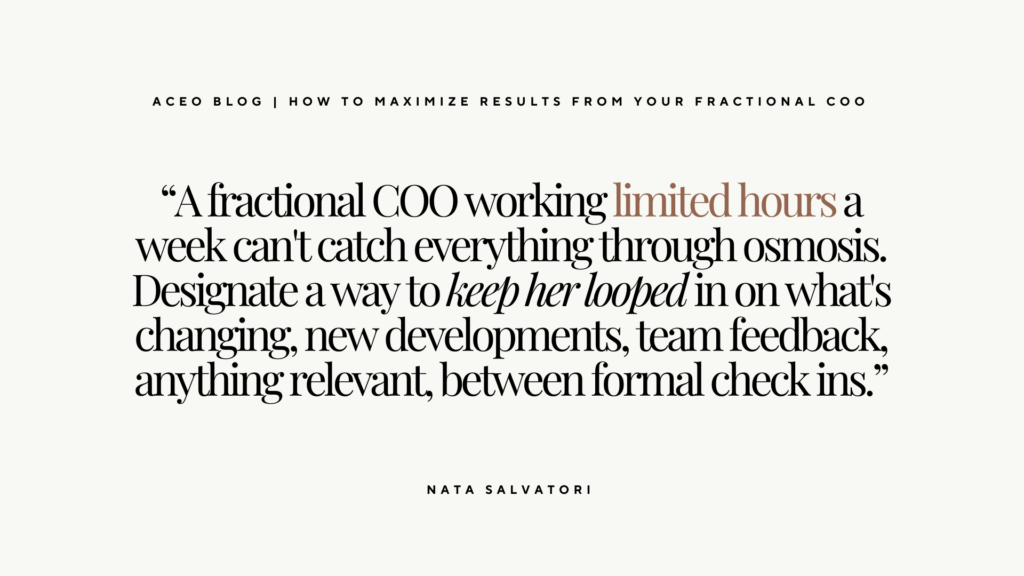
A fractional COO working limited hours a week can’t catch everything through osmosis. Designate a way to keep her looped in on what’s changing, new developments, team feedback, anything relevant, between formal check ins. This prevents her from spending her limited hours chasing updates instead of doing the actual work.
Don’t expect immediate transformation
The businesses that get frustrated fastest are usually the ones expecting sweeping change within the first few weeks. Real structural change takes longer than that to build and prove out. Expect early diagnostic clarity and small wins first, with bigger shifts compounding over the following months.
Treat the relationship as ongoing, not transactional
The founders who get the most from this kind of engagement treat their fractional COO less like a vendor delivering a fixed output and more like an embedded partner who needs context, trust, and real collaboration to do her best work. That shift in how you show up changes what’s actually possible in the engagement.
If you’re heading into a fractional COO engagement and want to set it up well from the start, that’s exactly the kind of conversation worth having up front. Fractional COO Solutions is built around real collaboration, not a hands-off transaction.
FAQ
What’s the biggest factor in getting good results from a fractional COO?
Giving her real decision-making authority within her scope, not just a longer list of tasks to execute. Engagements where every decision still routes back to the founder rarely produce the structural change that’s actually possible.
How much access should I give my fractional COO?
As much honest, unfiltered access to how the business actually runs as possible. Curated or partial information limits her ability to accurately diagnose the real problems.
Should I expect immediate results after hiring a fractional COO?
Not typically sweeping ones. Expect diagnostic clarity and small early wins in the first month, with larger structural changes building out over the following months.
How can I help my fractional COO work more efficiently?
Keep her looped in on relevant developments between formal check ins, rather than expecting her to catch everything through occasional touchpoints alone.
What’s a common mistake founders make that limits results?
Treating the relationship as a hands-off transaction instead of an active, collaborative partnership. The most effective engagements involve real ongoing input from the founder, not just a hire-and-forget approach.
Enjoyed this article? Follow Nata on Instagram for more practical insights, behind-the-scenes lessons, and tools to help you lead your business with more clarity and less overwhelm.
→ Instagram: @accidentalceo.co
→ Website: AccidentalCEO