
Growth is visible. Scaling is structural. That distinction matters more than it sounds like it should, because a lot of businesses are growing and getting harder to run at the same time, and they mistake that pain for a normal part of success instead of a sign that the structure never caught up.
A fractional COO’s whole job, when scaling is the goal, is closing that gap. Here’s what that actually involves.
Why growth without structure gets harder, not easier?
Picture two businesses that both land a big new opportunity. One responds by hiring fast, adding overtime, and pushing everyone to move quicker. Output goes up. So does the chaos, the coordination cost, and the number of things quietly slipping through. The other redesigns how work moves through the business first, so output can increase without every single thing depending on more effort from the same tired people. Both grew. Only one scaled.
Most founders default to the first pattern, because it’s what’s available when there’s no one dedicated to building the second option. That’s the specific gap a fractional COO fills.
What a fractional COO actually does to enable scaling?
Builds repeatable process before volume demands it. Instead of every new client or project reinventing how it gets delivered, there’s a system that holds at higher volume without more of your personal attention.
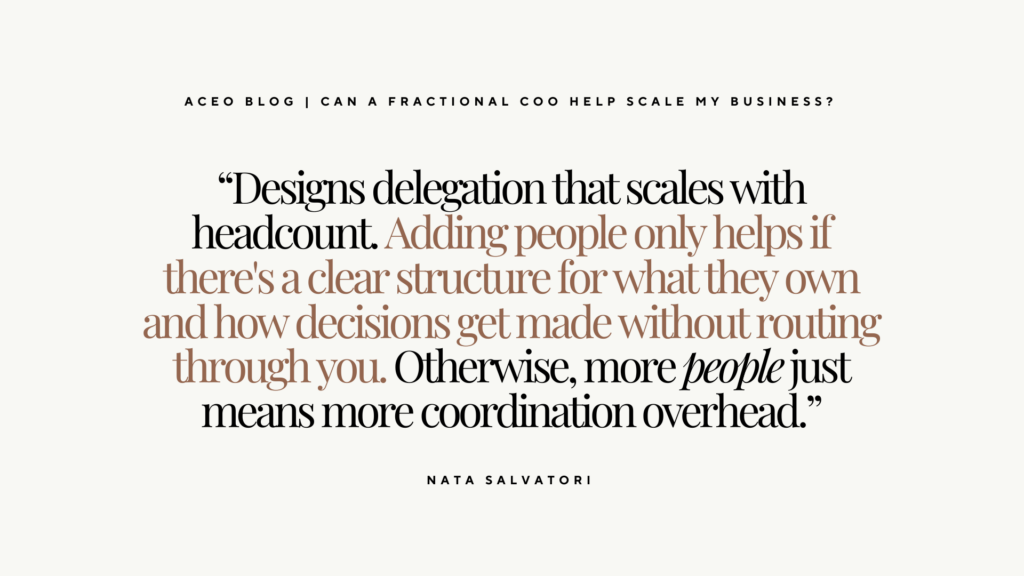
Designs delegation that scales with headcount. Adding people only helps if there’s a clear structure for what they own and how decisions get made without routing through you. Otherwise more people just means more coordination overhead.
Protects quality while volume increases. Scaling that sacrifices what made the business good in the first place isn’t really scaling. Part of the operational work is building the checks that keep standards intact as output grows.
Catches the strategic and operational mismatch early. Growth often outpaces the systems supporting it before anyone notices. A fractional COO is positioned to catch that gap while it’s still a minor fix, not after it’s become the reason a launch goes sideways.
What this looks like in practice?
A founder lands a wave of new business and immediately feels the strain in delivery. Instead of just hiring more hands to absorb the same broken process, a fractional COO maps where the process actually breaks under volume, fixes that specific bottleneck, and builds the delegation structure that lets the team handle the new volume without the founder personally checking every deliverable. The business grows. The founder’s week doesn’t get worse because of it.
Where this connects to more than operations?
Scaling often surfaces something underneath the systems problem: a founder who’s genuinely afraid of what happens if she stops holding everything together herself. That fear is real, and it’s not solved by a better process document alone. It’s why operational rebuilding and identity work tend to move together for founders doing this at a deeper level. If that resonates, it’s worth looking at both Fractional COO Solutions for the operational side and The RETURN Experience for the identity work that often needs to happen alongside it.
FAQ
Can a fractional COO really help my business scale?
Yes, specifically by building the systems, delegation structure, and process discipline that let output grow without every increase in volume requiring more of the founder’s direct time and attention.
What’s the difference between growing and scaling?
Growing means output or revenue is increasing. Scaling means that increase happens without a proportional increase in chaos, cost, or founder involvement, because the underlying structure was built to handle more volume.
How soon can a fractional COO impact scaling efforts?
It depends on where the biggest bottleneck sits, but many founders see meaningful shifts within the first 60 to 90 days as the most urgent structural gaps get addressed first.
Will scaling with a fractional COO mean I have to step back from the business?
Not necessarily, and not all at once. The goal is that your involvement becomes intentional rather than constant, freeing you for the strategic and relationship-driven work only you can do.
Is a fractional COO enough on its own to scale, or do I need other support too?
Operations is usually one major piece. If the resistance to letting go of control is also part of what’s holding growth back, coaching support alongside the operational work often produces a more durable result.
Enjoyed this article? Follow Nata on Instagram for more practical insights, behind-the-scenes lessons, and tools to help you lead your business with more clarity and less overwhelm.
→ Instagram: @accidentalceo.co
→ Website: AccidentalCEO