
A business coach works on you. A fractional COO works on the business. That’s the cleanest way to say it, and it’s also the reason so many founders end up frustrated with a role that was never built to solve their actual problem.
Both get lumped into the same general category, “outside help for a business that’s outgrown how it’s currently being run.” The comparison mostly falls apart once you look closely at what each one actually produces.
What a business coach does
A coach works on your thinking, your leadership, and your decision making. She asks the questions that surface your own blind spots, holds you accountable to what you say you’ll do, and helps you get clear on the vision and direction only you can set. The value lives largely in you: what you see differently, what you’re willing to do differently, and whether you apply it consistently once the session ends.
What a fractional COO does
A fractional COO works on the systems, the delegation, and the execution. When the engagement ends, something concrete exists that didn’t before: documented processes, a real accountability structure, a team that knows what it owns. The value lives in the business itself, not just in the founder’s head.
Why this comparison matters
If you hire a coach when what you actually need is someone building and running the operational fix, you’ll walk away with real clarity and no engine to execute it. If you hire operational help when what you actually need is to understand why you keep resisting the obvious next move, you’ll get a beautiful system that quietly falls apart because the founder behavior underneath it never changed.
Neither is the wrong choice in general. Either can be the wrong choice for your specific situation right now.
How to tell which one you actually need
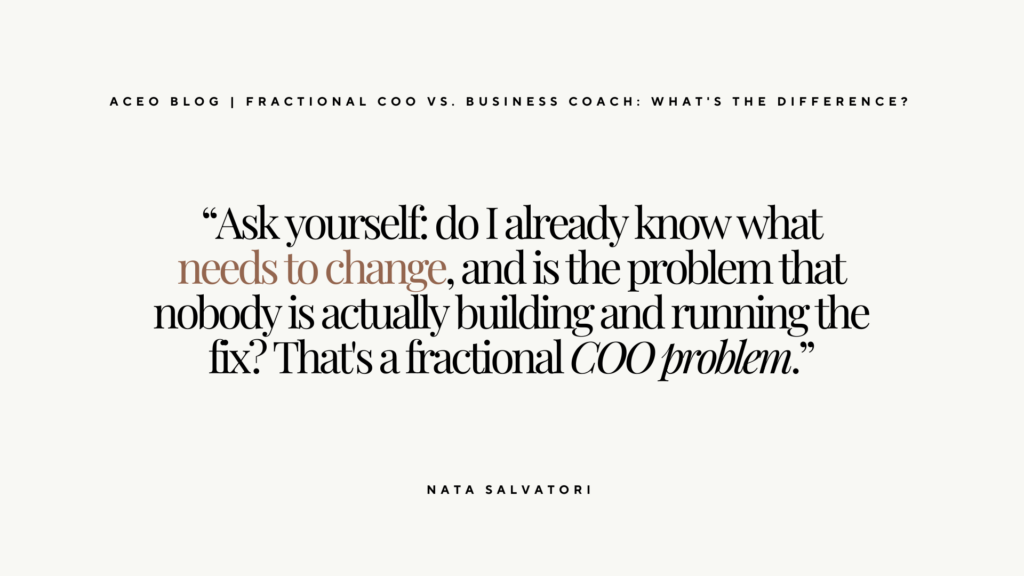
Ask yourself: do I already know what needs to change, and is the problem that nobody is actually building and running the fix? That’s a fractional COO problem.
Or: am I still unclear on what’s actually wrong, or do I understand it intellectually but keep circling back to the same resistance every time I try to act on it? That’s a coaching problem.
A lot of founders need both, at different points or even simultaneously, because operational problems often have identity roots, and identity work rarely sticks without something structural changing alongside it.
Where the two actually meet
This is the gap Nata works in specifically. She holds the operational rebuild and the coaching work that helps a founder actually let go of what the new structure requires her to release. If you’re not sure which side of the coach-versus-COO line you’re on, a Clarity Hour is built to surface that. If you know the deeper identity work is the bigger lever, The RETURN Experience is where that happens. If the operational side is clearly the gap, Fractional COO Solutions is where that work starts.
FAQ
What’s the core difference between a business coach and a fractional COO?
A business coach focuses on the founder’s thinking, leadership, and decision making. A fractional COO focuses on building and running the operational systems of the business itself. One produces personal clarity. The other produces institutional infrastructure.
Can a business coach also help with operations?
Some coaches touch on operational topics, but coaching is fundamentally advisory. A coach won’t typically log into your project management tool, build your delegation structure, or manage your team directly. That execution layer is what a fractional COO specifically owns.
Do I need a coach before I hire a fractional COO?
Not necessarily, and it depends on where you’re actually stuck. If you already know what needs to change operationally, you can start with a fractional COO. If you’re still unclear on the real problem or keep resisting the obvious next step, coaching first often makes more sense.
Is it common to work with both a coach and a fractional COO at the same time?
Yes, and for a lot of founders it’s the more effective path, since operational and identity level change often need to happen together to actually stick.
How do I know which one is the right fit for where I am right now?
Get an honest, outside read on what’s actually limiting you. If it’s structural, that’s a COO problem. If it’s a pattern of knowing what to do and not doing it, that points toward coaching. Often it’s genuinely both.
Enjoyed this article? Follow Nata on Instagram for more practical insights, behind-the-scenes lessons, and tools to help you lead your business with more clarity and less overwhelm.
→ Instagram: @accidentalceo.co
→ Website: AccidentalCEO